
![jose maria mercado[1]](mercEng_files/image024.jpg)
JOSÉ MARÍA MERCADO
MARTYR OF THE INEPENDENCE
IN THE WEST OF MEXICO
Translation in Progress
STATE COMMISSION FOR THE CELEBRATION OF THE BICENTENNIEL OF THE START OF
THE INDEPENDENCE MOVEMENT AND THE CENTENNIAL OF THE START OF THE MEXICAN REVOLUTION.
(BASE DOCUMENT)
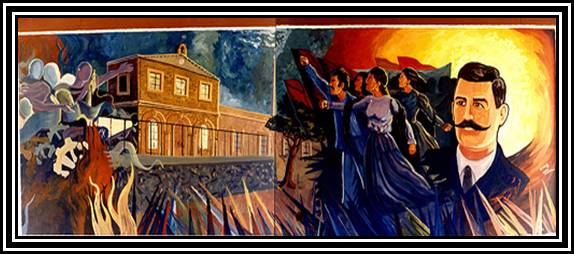
MURAL EVOCOTIVE OF THE NAYARIT WORKERS MOVEMENT,
BELLAVISTA STRIKE, 1905 .
The Mexican Independence Movement and the Mexican
Revolution are two historical events of great importance that form an essential
part of the historical and cultural identity of our nation..
Our present day national culture derives from the
sixteenth century Central American cultures as they have been transformed by
the Spanish Conquest. As a result, nobody can deny that our country has
become a great nation with a multicultural, multiethnic and poly-lingual
tradition.
The Spanish
presence in Nayarit dates back to 1524, when a group of a hundred soldiers led
by Captain Francisco Cortés de San Buenaventura, traveled through a major part
of the territory known today as the state of Nayarit. The real conqueror, however, was, , Nuno
Beltran de Guzman, who founded the Kingdom of New Galicia in later years. Tepic
was the capital, then under the name Santiago de Compostela. In 1540 the
capital was moved to the Valley Coatlán to the town that is currently called
Compostela. It remained there until 1560 when the city of Guadalajara became
the new capital of the kingdom due to strictly economic and political reasons,
due in large part related to the discovery and exploitation of rich mineral
deposits in Zacatecas
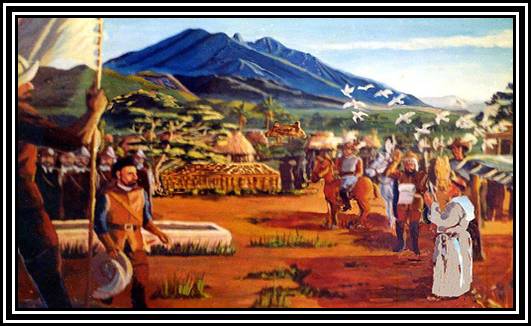
FOUNDATION OF COMPOSTELA AS THE CAPITAL OF NUEVA
GALICIA, 1540.
After 300 years of Spanish rule, Nueva Galicia entered
a stage of very important economic, political and social change. The society at
his time experienced an unprecidented economic boom: a trade port opened in
Matanchen for maritime commerce, the town of Tepic was promoted from a parish
to a vicarage, and the port of San Blas was founded in 1768.
The Tepic
valley and the Nayarit coast remained relatively calm for many years, however,
the Grito de Dolores, 15 September 1810, caused a stir. The news first came to
Tepic, the surrounding towns and then to the mountains. Finally, the
independence movement in the territory of the current state of Nayarit, began
with the arrival in Tepic of the priest from Ahualulco, Jose Maria Mercado, who
declared the insurrection in this area on 13 November 1810. He formed a small
army and invited Juan Jose de Zea, Subdelegate of Ahualulco to join him. Zea
immediately accepted and from that moment became his deputy in the campaign.
The insurgent José Antonio Torres, commissioned Mercado to fight for
independence in the region of Tepic and seize the port of San Blas.
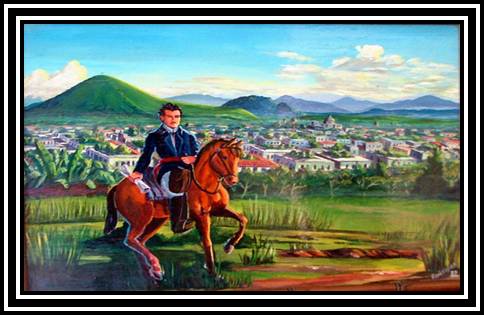
THE CURA JOSÉ MARÍA MERCADO, INSURGENT LEADER OF THE
REGION.
On the journey from Ahualulco to Tepic, they enlisted
in the cause people of Ixtlan del Rio, Ahuacatlán, Tetitla and
Tequepexpan. November 23, 1810 they
peacefully took the city of Tepic, where new allies joined the movement,
including some soldiers of the veteran’s guard, as well as some illustrious
tepiqueños Creoles (locally born people of pure or mostly Spanish
ancestry): Jose Arias, Rafael Maldonado, Rafael Hijar and Manuel de Zea. On
November 30 the Cura Mercado announced his appointment by solemn edict given by
Hidalgo, designating him as "Commander General of the Armies of the
West". On December 1st insurgents seized San Blas, after the Cura Mercado
had notified the port commander Joseph Lavayen and requested the handover of
the settlement, arguing that his purpose was to save the country and religion
from the dangers posed by the French invasion of Spain and the enemies of the
country that threatened the fairness, independence and the Christian faith. The
Cura Mercado sent 36 guns to Guadalajara to support the Cura Miguel Hidalgo y
Costilla.
Mercado arranged to send Marcelino Miramontes to the
Sierra de Nayarit, to disseminate the insurgent’s ideas, but a royalist
missionary, Rudesindo Angles, took Miramontes prisoner and sent him to the
commander Miguel Ochoa, who was at the Guazamota Mission. Ochoa sent troops to
the towns of San Juan Peyotan, Huaynamota, Ixcatán and Santa Teresa to halt
rebel advance.
On January 1811, Mercado sent 600 insurgents to
Guazamota, where they clashed with the royalist army, killing four soldiers and
20 insurgents in Jesús María. Such conflicts occurred with some frequency
and the movement spread into the mountains of the Huicholes.
Mercado again headed toward Tepic and subsequently took the road to Guadalajara, intending to meet with the Cura Hidalgo, but while he was in Plan de Barrancas learned of the defeat of Hidalgo at Calderón bridge, and returned immediately to the port of San Blas.
The Royalist army commanded by José de la Cruz set out recover Tepic, which was held by the insurgent Rafael Hijar. however, the counterrevolutionary movement, led by the local priest Nicolas Santos Verdin, appeared in the port of San Blas, supported by members of the Navy and the petty officers based in the port. They surprised the insurgents on the night of January 31. While seeking an escape route, Mercado accidentally fell off the cliff of the hill, and died the same night, while his top lieutenants were taken as prisoners. The insurgents were pursued by José de la Cruz who made prisoners of Juan José of Zea, the father of José María Mercado and some of his followers. On 12 February they were ordered shot in the main square of Tepic, and their corpses were hung at various points in the city.
Before these events, on 8 February 1811 general José
de la Cruz, entered Tepic to be greeted by a great celebration, the streets
were adorned and many people came meet him, there was dancing, feasts and
sermons. That same day, General de la Cruz issued a proclamation against the
insurgent’s side
Finally, eleven years after the start of the fight,
the independence of Mexico was achieved.
Independence
from the Spanish crown created an important perspective for the birth of a new
nation. Influenced by the liberal ideas of the era, they established a republic
with the liberties that a social and political movement of that nature
entails. Men and women who gave their
lives for freedom and justice became the heroes who left us a free homeland,
and who year after year, we remember and affirm our respect and admiration.
One hundred years later, a new social and political
movement eagerly seeking autonomy, democracy and justice for Mexicans,
developed what was here and elsewhere in the world known as the Mexican
revolution.
Nayarit society was unhappy, as was the rest of the
country, with the dictatorship of General Porfirio Díaz, whose system generated
investments, progress and great wealth for some, but was unable to improve the
living conditions of millions of marginalized Mexicans steeped in poverty.
Many peasants were stripped of their lands and were as
pawns on estates; workers had low wages and suffered inhuman hours, lacked any
social benefit and those who dared to fight for better conditions were
repressed and imprisoned. For that reason, one of the first workers movements
of the 20th century occurred in Nayarit:
the strike of March 20, 1905, in which the men and women workers of the
Bellavista textile factory, headed by the brothers Elijah, proved to be
faithful representatives of the libertarian national magonista movement.
THE QUINTERO SISTERS: FORERUNNERS OF THE
WORKERS MOVEMENT IN THE TERRITORY OF, 1894.
With the battle cry of Francis I. Madero against
Porfirio Díaz regime, the towns of Nayarit which had remained estranged from
one another since the time of Manuel Lozada reconciled in the revolutionary
struggle of 1910-1917, and thus began the Mexican Revolution in Nayarit, an
event that produced institutions whose goal was to deliver social justice and which
became the foundations of a new society.
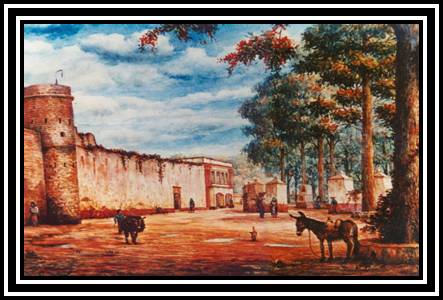
BELLAVISTA TEXTILE FACTORY AT THE BEGINNING OF THE 20TH
CENTURY.
Madero's revolutionary movement in what is now the
Territory of Tepic formally began in the town of Ixtlan de Rio, where without
the knowledge of the Porfirista
authorities they shouted, “Viva Madero”
(long live Madero)!
The first political chief of the revolution in the
Territory of Tepic was General Martin Espinosa, whose tenure was from 1911 to
1913. On 24 May 1911, when the revolutionary forces led by Gen. Martin Espinosa
entered the city of Tepic, marching down the Lerdo de Tejada street to the main
square. One of his first actions was to call elections and ignore the incumbant
City Council president, Bernard L. Diaz Martinez. Mr.
Carlos Castilla was elected mayor.
The first revolution in the territory of Tepic
political chief was general Martín Espinosa, whose management was from 1911 to
1913. It was May 24, 1911, when the
forces commanded by general revolutionary Martín Espinosa entered the city of
Tepic, marching by the street Lerdo de Tejada until the main square. One of the
first actions was convened to the City Council elections and ignore the
President porfirista Bernard l. Martinez,
resulting elected municipal President Mr. Carlos Castilla.
The last porfirista political Chief of Tepic territory
was general Mariano Ruiz, who left the city towards the State of Jalisco,
leaving the region in the hands of the maderistas.
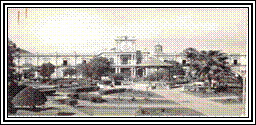
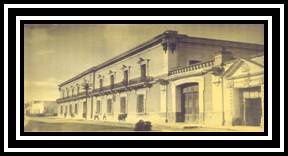
TEPIC
PENITENTIARY AND SAN ROMÁN GARDEN, QUE DOMINÓ
LA REGIÓN
19TH .CENTURY. SIGLO
XIX.
Con el grito de ¡¡ Viva Reyes !!, se inicia otro
episodio de la historia de Nayarit, movimiento dirigido por Plácido Quintero y
Juan Uribe Osuna, quienes intentaron tomar el palacio del Territorio (hoy ex
Hotel Imperial), el 23 de noviembre de 1911, el cual fue defendido por el
general Martín Espinosa.
Los reyistas se dedicaron a saquear algunas oficinas
públicas de Tepic, Xalisco y Compostela, esta última defendida por los vecinos,
entre los que figuraron Ramón Ibarría, Pánfilo Fletes, Fernando Zúñiga, José
Ulloa, Leopoldo León, entre otros. Aquí los reyistas fueron perseguidos hasta
el rancho de Las Cuevas, donde fueron dispersados y prácticamente se terminó
dicho movimiento.
El 14 de marzo de 1912, se sublevó el teniente del
Octavo Batallón Miguel Guerrero y quiso apoderarse de la penitenciaría, a pesar
de la resistencia lo logró y liberó a todos los presos. Sin embargo, la fuerzas
maderistas se organizaron para la defensa de posibles ataques de las huestes de
Guerrero, pero después de tomar el hospital militar localizado en el ex
convento de
El 22 de febrero fueron asesinados Don Francisco I.
Madero y José María Pino Suárez y cinco días después, el día 27 se reunieron el
general Martín Espinosa, Rafael
Buelna, Isaac Espinosa y otras cinco personas, quienes ya habían
desconocido al usurpador Victoriano Huerta.
El 5 de marzo de 1913, el ejército huertista persiguió
a los generales Espinosa y Buelna, perdiendo contacto entre ellos. El 25 de
abril Buelna regresa y ataca Acaponeta arrebatándole la plaza a los huertistas.
En noviembre decide tomar Santiago Ixcuintla, inmediatamente después se
registraron varios combates contra tropas federales en la hacienda de
Para este año de 1914, el general Martín Espinosa
abandonó la jefatura política de Tepic, quedando en manos de los usurpadores
huertistas, Agustín Migoni, Miguel Gil y, por último, el general Domingo
Servín.
En junio de 1915, Tepic estaba en manos de los
carrancistas, cuyo jefe militar el general Ernesto Damy, defendió la plaza
contra las fuerzas de Rafael Buelna, quien ya se había pasado al ejército
villista.
Como jefe máximo de la revolución, don Venustiano
Carranza convocó el 19 de septiembre de 1916 al congreso constituyente en la
ciudad de Querétaro, por el territorio de Tepic los diputados representantes
fueron Marcelino Cedano, Cristobal Limón y Juan Espinosa Bávara, realizando un
magnífico papel en la elaboración y
aprobación de
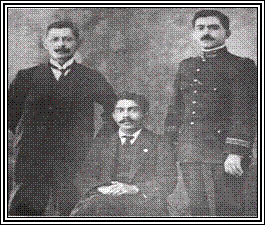
LOS DIPUTADOS CONTITUYENTES POR EL TERRITORIO DE
TEPIC, 1916-1917.
Juan Espinosa Bávara, Cristóbal Limón y Marcelino
Cedano
Nuestros diputados se habían propuesto promover en el
Congreso Constituyente, que el territorio de Tepic se elevara a estado libre y
soberano, presentando la iniciativa el 16 de diciembre de 1916. Esta propuesta
de los representantes tepiqueños se vio coronada con la publicación de nuestra
Carta Magna, dándose a conocer el 5 de febrero de 1917.
El 17 de marzo de ese año, el general Juan S. Torres,
entregó el gobierno al general Jesús M. Ferreira con el carácter de gobernador
interino, quien se encargó de convocar a elecciones el 22 de abril de 1917,
obteniendo la mayoría de los sufragios el C. José Santos Godínez, erigiéndose
en el primer gobernador constitucional del estado de Nayarit, cuyos adversarios
fueron los luchadores sociales Enrique G. Elías y Esteban Baca Calderón.
En 2010 se
cumplirán 200 años del inicio del movimiento de Independencia y 100 años del
inicio de
![0005493[1]](mercEng_files/image033.gif)
JOSÉ SANTOS GODINEZ
PRIMER GOBERNADOR CONSTITUCIONAL DE NAYARIT
Debido a la relevancia que tienen dichos episodios de
la historia de México es que se decide crear una comisión nacional y comisiones
de la misma naturaleza en cada uno de los estados, para conmemorar y celebrar
el Bicentenario del inicio del Movimiento de Independencia y Centenario del
inicio de
Entre las principales tareas que le competen a dicha
Comisión se encuentra la planeación, organización y ejecución de cada una de
las actividades y eventos conmemorativos del Bicentenario y Centenario,
respectivamente, así como garantizar la acción coordinada con las instancias de
Gobierno, instituciones y organismos del sector social y privado que llevarán a
cabo las actividades y proyectos.
Del mismo modo,
Seis son los grandes objetivos a cumplir:
- Mostrar la importancia de Nayarit como lugar
fundacional de
- Difundir la participación de la entidad en los
movimientos de
- Impulsar, con el programa general de las
celebraciones, un movimiento en el que se festeje y se reivindiquen los
hechos históricos, así como las diversas identidades e influencias que
tuvieron lugar en Nayarit y la presencia de los nayaritas en el contexto
nacional.
- Cubrir el Estado con la celebración del
Bicentenario y Centenario.
- Crear programas de intercambio
histórico-culturales entre los municipios del estado, involucrando a toda
la población, especialmente a los niños y jóvenes de nuestra entidad.
- Promover el rescate y dignificación de nuestro
patrimonio cultural, como es el caso de la rehabilitación y puesta en
valor de
A ello se agregarán actividades multidisciplinarias,
como son: exposiciones, publicaciones, producciones audiovisuales,
conferencias, talleres, cátedras, rescates documentales, investigaciones,
conciertos, concursos, entre otras, enfocadas a generar una amplia
participación social y reavivar la memoria histórica.
El pueblo tiene en su memoria histórica un conjunto singular de testimonios y expresiones de su patrimonio cultural, tangible e intangible, sin el cual las formas fenoménicas de la cultura carecerían de sentido. Esta conmemoración de la historia de México subraya la singularidad de nuestro pasado y nuestra cultura, es un gran momento para reencontrar nuestra identidad, reintegrarnos como sociedad, redefinir los valores que han conformado el ser mexicano y crear un horizonte de civilización más amplio, el del mundo iberoamericano.
1. ORGANISMOS E INSTITUCIONES PARTICIPANTES:
- Consejo Estatal para
- Secretaría General de Gobierno.
- Secretaría de Educación Básica.
- Secretaria de Educación Media, Media-Superior y
Superior
- Servicios de Educación Pública del Estado de
Nayarit.
- Secretaría de Turismo.
- Secretaría de Planeación.
- Secretaría de Desarrollo Económico.
- Secretaría de Salud.
- Secretaría de Desarrollo Rural.
- Secretaría de Obras Públicas.
- Secretaría de Finanzas.
- Instituto Nayarita de
- Instituto de
- Instituto Nayarita del Deporte y de
- Instituto Nacional de las Personas Adultas
Mayores.
- Universidad Autónoma de Nayarit.
- Instituto Tecnológico de Tepic.
- Universidad Tecnológica de Nayarit.
- Universidad Tecnológica del Bahia de Banderas.
- Universidad Tecnológica de
- Consejo de Ciencia y Tecnología de Nayarit.
- H. Congreso del Estado.
- Tribunal Superior de Justicia.
- Entidades de Gobierno Federal: (CONACULTA, INAH, INBA,
CDI, SEDESOL, SAGARPA, STyPS, SE, SEMARNAT, PROFEPA, CFE, BANOBRAS, RAN,
INEGI, IFE, etc. )
- Asociaciones Civiles y Empresariales: (CAIN,
Ateneo, Plástica Nayarita, Seminario de Cultura Mexicana, COPARMEX,
CANACINTRA, CANIRAC, CONCAMIN, CANACO, CMIC, Asociaciones de Hoteles y
Moteles del Estado, Colegio de Arquitectos, Colegio de Abogados, Colegio
de Ingenieros, etc.)
- Clubes Rotarios y de Leones.
- COMISIONES
DE TRABAJO.
Comisión de Investigación Científica y Tecnológica.
Comisión de Desarrollo Social y Económico
Comisión de Patrimonio Natural, Cultural y Desarrollo
Artístico.
Comisión de Promoción, Gestión y Difusión.
Comisión Editorial.